AI research
Research Intern on the Lockheed Martin ATL Research Project, March to July 2026.
Conducted proprietary research for Lockheed Martin Advanced Technology Labs in cybersecurity, focused on AI and agentic systems.
Lockheed Martin
ATL Research Project
Research Intern
- Researched the cyber capabilities of modern LLM AI agents
- Presented on major breakthroughs, roadblocks, and key findings from our research
- Operated within a resource constrained environment
- Built a test environment from scratch to understand important issues and design solutions
- Documented observations, discoveries, solutions, and the processes behind building our solutions
Jarvis
My personal AI agent. I started it in June and it's now 333 commits and 40 build phases in, with a Windows installer on release 1.0.8.
A FastAPI backend runs the agent loop, memory, and tools. It works with Claude, OpenAI, Gemini, Groq, or local models through Ollama. Any device talks to it over one WebSocket: the web app, the Electron desktop app, or a Raspberry Pi with a mic and speaker. Wake word and speech-to-text run locally with openWakeWord and Whisper.
Tools are approval-gated. On a screen I get an approve button. On a speaker-only device the call is denied and Jarvis says why. It has 53 test files and its own evals for tool selection and task planning.
AI engineering at Proto
I built an AI pipeline that generates full courses of lessons on self-hosted language models, with a quality check on everything it writes. I also worked on retrieval so lessons draw on real source material.
A course takes shape lesson by lesson. Anything that fails the check gets rewritten.
Project Pareto
Our senior capstone asks how much defensive capability a small team can build with AI and public knowledge, for OT networks, small businesses, and churches. I lead the six-person team and work on the infrastructure side.
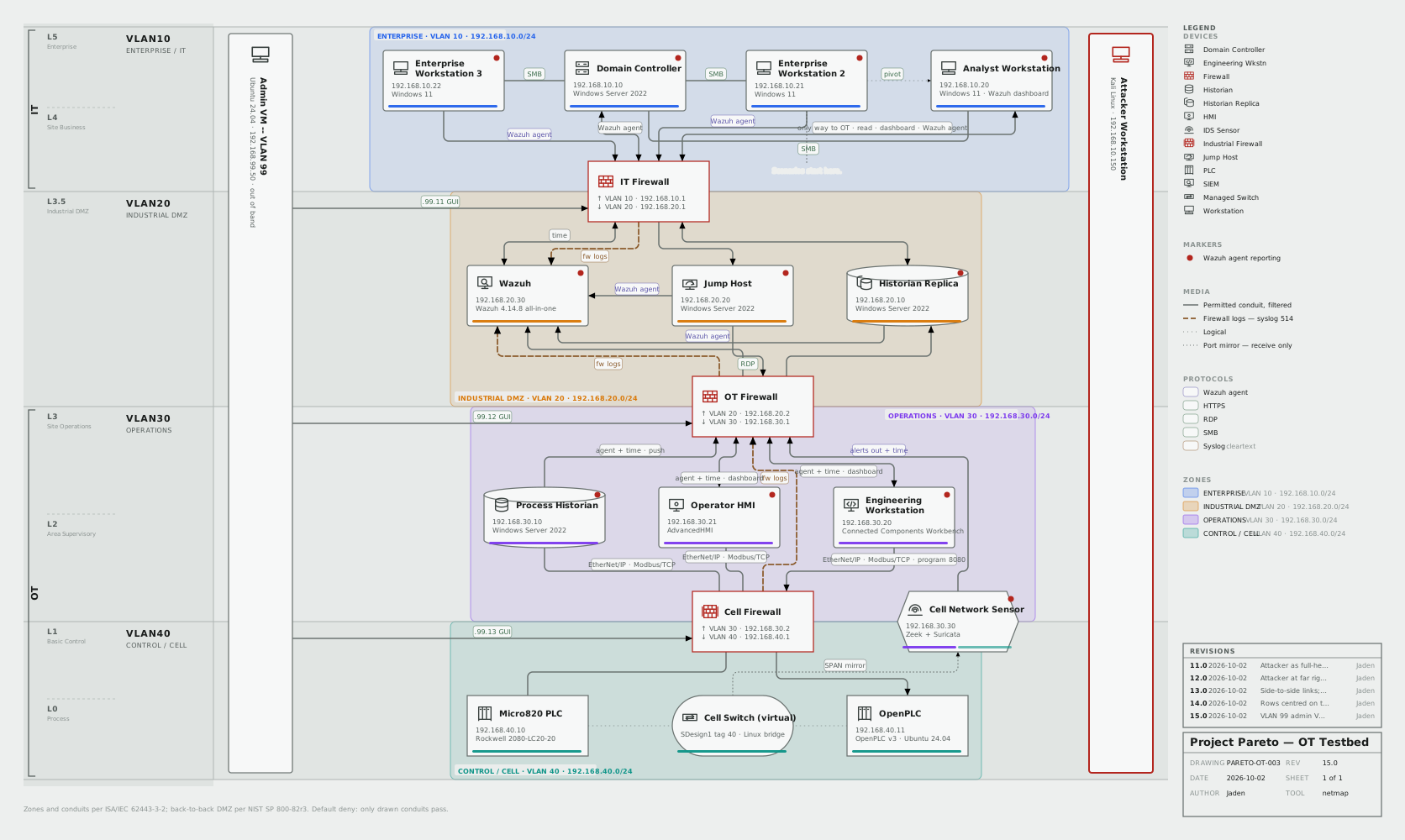
Our test range on Proxmox follows the Purdue model: Enterprise, Industrial DMZ, Operations, and Cell zones, split by three OPNsense firewalls. Wazuh in the DMZ collects from agents on the Windows hosts, and a Zeek and Suricata sensor watches the cell network from a mirror port. At the bottom sit a Rockwell Micro820 PLC and an OpenPLC instance. Attacks start from a Kali box in Enterprise.
The zones, firewalls, and Wazuh are up. Next we wire in the PLC and route firewall and sensor logs into Wazuh.
Teaching
As a Cyber Student Fellow I teach two seminars to 30+ underclassmen, and I rebuilt almost all of their curriculum. Basic Cyber Maneuvers takes beginners through Linux, Windows, and networking on TryHackMe, ending with OverTheWire Bandit, OSINT, and NCL prep.
Advanced Cyber Maneuvers walks the cyber kill chain on CU's Cyber Range, from Nmap scans through EternalBlue, pivoting, Modbus attacks, privilege escalation, and Sliver C2. It ends with CEDAR FLAG, a mock cyber operation modeled on the Air Force's Red Flag.
Basic: 13 weeks of fundamentals, rebuilt
- Linux
- file system
- shells
- SSH
- Vim
- tmux
- PowerShell
- registry
- TCP/IP
- DNS
- Bandit
- OSINT
- NCL prep
Advanced: the kill chain, on the Cyber Range
- ReconNmap, Rustscan, Wireshark
- Enumerationreading scan results
- ExploitationEternalBlue, Shellshock, Modbus
- Pivotingproxychains
- Privilege escalationLinux and Windows
- C2 and objectivesSliver, Hashcat, Hydra
TechStop
I started at TechStop, Cedarville's IT help desk, as a Tier 1 technician in August 2024, working tickets and calls across hardware, software, and network problems. A year later I was promoted to Technical Lead.
Now I lead the 15 to 20 technicians who handle support for the whole university. I oversee incident resolution and mentor newer techs.
We standardized customer follow-up to a call, a text, and an email, then wait for the customer to respond. Resolved tickets get closed, and a new one opens if the problem comes back. Comparing my first year as lead, August 2025 to July 2026, with the year before, average recorded resolution time, from ticket creation to closure, fell about 27%, from 37.8 to 27.5 hours. We also closed about 30% more Personal Technology tickets, 775 against 598.
I'm also an Eagle Scout.
Incoming
Team, 15 to 20
lead: me
Resolved
| Ticket reports, Aug to July | 2024–25 | 2025–26 |
|---|---|---|
| Avg recorded resolution time | 37.8 h | 27.5 h |
| Personal Technology tickets closed | 598 | 775 |
Board tickets are examples. The table is from our ticketing reports.
Competitions
National Cyber League, Spring 2026 Individual Game: 2nd of 7,011, with a perfect 3,000 of 3,000 points, 99% accuracy, and no hints. One season earlier I placed 25th of 7,876. In the Team Game we placed 9th of 3,634, up from 21st of 4,214.
In CCDC, where student teams defend a live network against a professional red team, we won the 2026 Ohio state round, placed 2nd at Midwest regionals, and reached the wildcard round for nationals.
At CyberSEED 2026 our Cedarville team of four placed 2nd and won $2,500.
This is my first year in the NSA Codebreaker Challenge, and I've finished the first three tasks so far.
NCL Spring 2026 · Individual Game · score report
2nd
of 7,011
3,000 / 3,000 points
99% accuracy, 0 hints
| Category | Points | Accuracy |
|---|---|---|
| Open Source Intelligence | 385 | 100% |
| Cryptography | 360 | 100% |
| Password Cracking | 355 | 95% |
| Log Analysis | 300 | 100% |
| Network Traffic Analysis | 300 | 100% |
| Forensics | 300 | 94.7% |
| Scanning and Recon | 300 | 100% |
| Web App Exploitation | 300 | 100% |
| Enumeration and Exploitation | 300 | 100% |
| Competition | 2026 result |
|---|---|
| NCL Individual | 2nd of 7,011 |
| NCL Team | 9th of 3,634 |
| CCDC Ohio | 1st, state champions |
| CCDC Midwest regional | 2nd, wildcard round |
| CyberSEED | 2nd, team of 4 |
| NSA Codebreaker | 3 tasks done, in progress |